
Vision boards
Vision board ideas for 2027: categories, words and images to include
Stuck on what to put on your vision board for 2027? Here are life areas to cover, words and short sentences, image ideas, layouts and yearly themes, plus a simple way to keep the board useful after January.
Published
What makes a good vision board idea
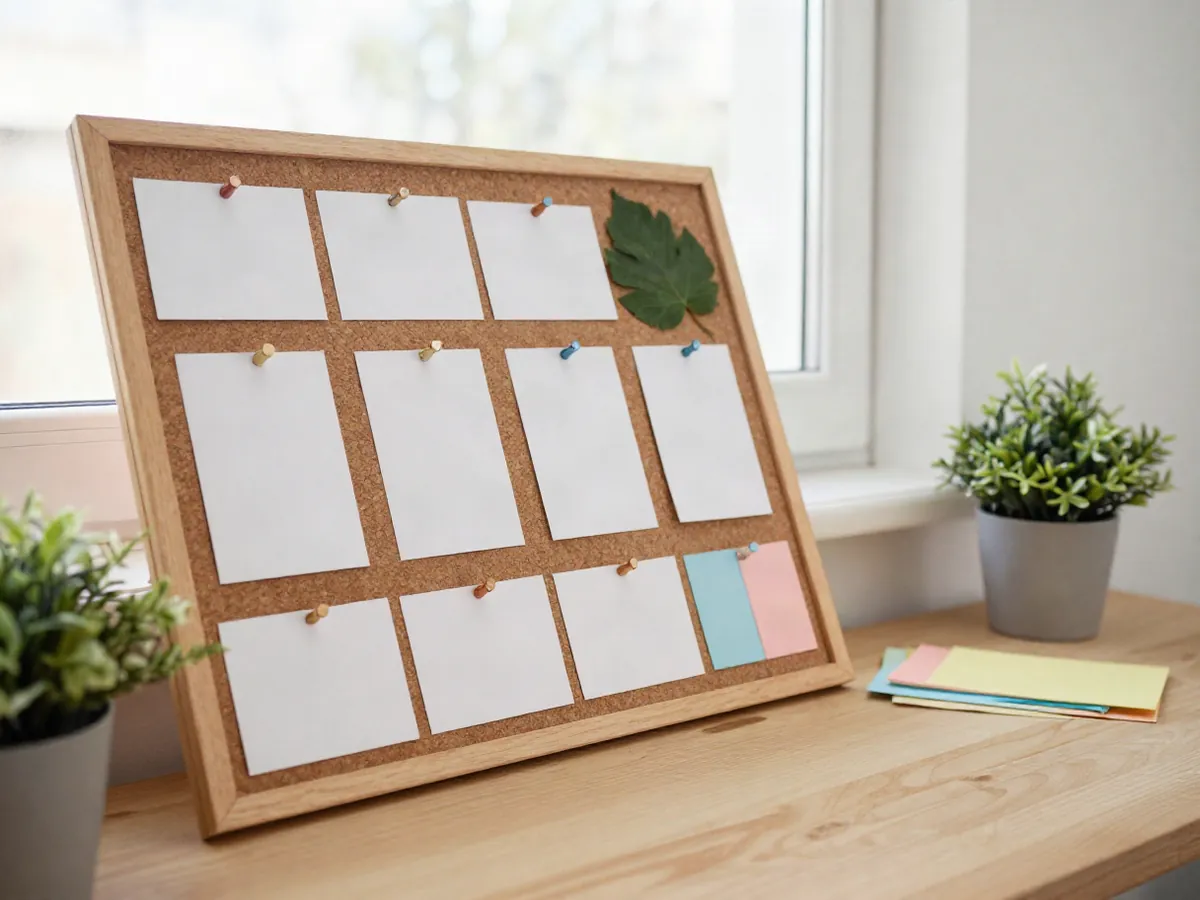
A vision board is a collage of images and words that remind you what you want to grow towards. The best ideas are not the prettiest pictures on the internet. They are the ones that make you think, every time you look, "right, that is what I am working on", and that point to something you can actually do this week.
This list is meant to help you fill a board for 2027 without copying someone else's life. Pick what fits, skip what does not, and leave empty space. If you have not made a board before, our guide to making a vision board you will actually use covers the step-by-step process; this page focuses on what to put on it.
Life areas to consider
Most boards feel balanced when they touch three to five areas of life. You do not need all of these. Choose the ones that matter most this year:
- Health habits: sleep, movement, food you enjoy cooking, time outdoors. Picture the routine, not a body shape.
- Work and learning: a skill you want to build, a project to finish, a course, a new role.
- Money: a savings habit, paying down a balance, a budget you check monthly, a planned purchase.
- Home: a tidy corner, a plant, a room you want to make feel like yours.
- Relationships: regular calls with family, a friend you want to see more, a kind of partner you want to be.
- Creativity and play: drawing, music, writing, a craft you used to love.
- Rest: slow mornings, a phone-free evening, a holiday you plan rather than just wish for.
- Community: volunteering, a club, helping a neighbour, joining something local.
Words and short phrases
Words help a board say what images cannot. Keep them short, in your own voice, and believable enough that you do not wince when you read them. Some ideas to adapt:
- Single words: steady, brave, rested, curious, generous, focused, home, enough.
- Process phrases: "Ten minutes counts", "Show up, then adjust", "Small and often".
- Bridge sentences: "I am learning to ask for help", "I am becoming someone who finishes things".
- Questions: "What would make today a bit lighter?", "What is one brave email?"
- Permission notes: "Rest is part of the plan", "I can start again on Monday, or now".
- Your yearly word in large letters, with three smaller words underneath for how you want to feel.
Image ideas that point to action
Research on mental simulation suggests that picturing the process of reaching a goal is more useful than picturing only the finished result. In a study by Taylor and colleagues, students who imagined the steps of studying made more progress than students who only imagined getting a good grade. You can build that idea straight into your board.
For every "result" image, try adding one "process" image next to it. Some examples:
- Instead of only a finish-line photo, add running shoes by the door.
- Next to a picture of a calm home, add a photo of your own kitchen counter, cleared.
- Beside a dream job image, pin a notebook page with your portfolio to-do list.
- With a travel photo, add a picture of a savings jar or a calendar with the trip blocked out.
- For relationships, use a real photo of people you love rather than a stock image of strangers.
Where to find images
Your own photos are often the most powerful, because they show your real life slightly ahead of where it is now. Old magazines, postcards, tickets, fabric scraps, pressed flowers and paint swatches also work well and make the board feel personal.
If you use pictures from the internet, choose ones you are allowed to use and avoid images built around other people's bodies, wealth or relationships. Comparing yourself to a stranger's highlight reel can make the board feel like a list of what you lack rather than a picture of what you are building.
Layout ideas
How you arrange the board changes how you use it. Try one of these layouts:
- Four quarters: one life area in each corner, with your yearly word in the middle.
- A timeline: four columns for the seasons, with one focus per season.
- A ladder: small step at the bottom, steady habit in the middle, bold goal at the top.
- Feeling first: three feelings across the top, and under each one the images that create it.
- A pocket board: a small card or phone wallpaper you see dozens of times a day.
- A journal spread: two pages in your notebook that you can add to as the year goes on.
Theme ideas for the year
Some people prefer one theme instead of many goals. A theme gives you a lens for decisions. If one of these fits, build the board around it:
- A year of basics: sleep, water, walks and an earlier bedtime.
- A learning year: one skill, practised a little every week.
- A slower year: fewer commitments, more margin, saying no kindly.
- A connection year: more calls, more shared meals, fewer scrolled evenings.
- A finishing year: complete what you started before starting something new.
An imagined example board
Imagine Mert, who chooses "steady" as his word for 2027. His board has three areas: health, work and friends. For health, he pins a photo of his own trainers by the door next to a picture of a forest path he likes to walk. For work, he adds a screenshot of the course he wants to finish and a sticky note that says "Two lessons a week". For friends, he uses a real photo from a dinner last spring and writes "One call every Sunday".
In the corner he leaves an empty square for whatever the year brings. Every first Sunday of the month he looks at the board, ticks what moved and adjusts one step. In April he realises the course pace is too fast, so he changes the note to "One lesson a week". The board stays honest, so he keeps looking at it.
Keep the board reviewable
A board helps most when you treat it as a plan you can update, not a wish you hang and forget. Studies of goal pursuit by Oettingen and Mayer found that positive expectations based on your real situation predicted more effort than daydreams alone. So give each area one small next step and look at it again regularly.
Once a month, stand in front of the board for five minutes. Ask: what moved, what stalled, and what is the next small step? Write one if-then plan for the area that stalled, such as "If I skip my walk on Monday, then I will walk after lunch on Tuesday." A meta-analysis by Gollwitzer and Sheeran found that if-then plans like this help people follow through on goals.
Common mistakes
These are the patterns that most often turn a vision board into wall art:
- Too many goals. If you cannot read the board in ten seconds, remove half of it.
- Only outcomes. Add at least one action image for each big result.
- Other people's dreams. If an image came from a trend rather than from you, ask whether you actually want it.
- Hiding it away. Put it where your eyes already go: near the kettle, by your desk or as your lock screen.
- Treating it as a promise. A board is a reminder and a planning tool. It cannot guarantee any outcome, and a slow month does not mean you did it wrong.
Frequently asked questions
When should I make my 2027 vision board? Any time that suits you. Many people make one in late autumn or January, but a board made in March works just as well.
Should I make a digital or a paper board? Either. Paper is more tactile and memorable for many people; digital is easier to update and to see every day. Some people do both.
How many images should I use? Start with eight to fifteen. Leave some empty space so you can add things as the year shows you what matters.
What if my goals change? Change the board. Updating it is a sign that you are paying attention, not that you failed.
Sources and further reading
- Taylor, Pham, Rivkin & Armor (1998): Harnessing the imagination. Mental simulation, self-regulation, and coping (PubMed) — Students who simulated the process of studying made more progress than those who simulated only the outcome.
- Oettingen & Mayer (2002): The motivating function of thinking about the future: expectations versus fantasies (PubMed) — Positive expectations predicted more effort and success; positive fantasies predicted less.
- Gollwitzer & Sheeran (2006): Implementation intentions and goal achievement, a meta-analysis (University of Konstanz repository) — If-then plans showed a medium-to-large average effect on goal attainment.
Keep exploring
All blog posts
The law of attraction explained, and a grounded way to use it
The law of attraction says your thoughts draw matching experiences into your life. Here is where the idea comes from, what the evidence does and does not show, and a practical way to use its best parts without blaming yourself.
Read article
The 3-6-9 method explained honestly: how to do it and what to expect
Write one intention three times in the morning, six in the afternoon and nine at night. Here is how the 3-6-9 method works, why repetition can sharpen focus, where it falls short and a calmer version you can keep up.
Read article