
Vision boards
How to make a vision board you will actually look at
Most vision boards are made in one inspired evening and forgotten within a week. Here is how to build a small, honest board around how you want to feel, put it where you will see it and pair it with one weekly step.
Published
Why most vision boards end up ignored
Making a vision board is fun. You collect pictures, cut out words, arrange everything on a large sheet and feel a lift of hope when it is done. Then the board goes behind a door or into a drawer, and a month later you can barely remember what was on it. That is not a personal failure. Most boards are built for the evening you make them, not for the ordinary Tuesday three weeks later.
A board you actually look at has a different design. It is smaller, more personal and easier to read at a glance. It is placed where your eyes already go, and it is connected to something you do, not only to something you hope for. This guide walks through that kind of board step by step, with examples, common mistakes and an honest look at what a vision board can and cannot do.
What a vision board is for
A vision board is a visual reminder of what matters to you: a handful of images and words that show the life, feelings or direction you want to move towards. It can be a sheet of card on the wall, a page in a journal, a pinboard above your desk or a private collection of images on your phone. The format matters much less than whether you see it and whether it still feels true when you do.
It helps to treat the board as a compass rather than an order form. It is not there to list every item you want to own. It is there to remind you, on a busy day, of the kind of life you are choosing to build, so that small decisions such as what to do with a free hour or whom to call back can line up with it a little more often.
Start with how you want to feel, not what you want to have
Before you look for a single picture, spend ten minutes with a notebook. Boards built around objects tend to go stale fast, while boards built around feelings stay relevant for longer, because many different days and choices can feed the same feeling. Ask yourself these questions and write short, honest answers:
- How do I want to feel on an ordinary weekday six months from now?
- Which moments in the past year felt most like me, and what did they have in common?
- What do I want more of in my days: rest, adventure, connection, focus, creativity or calm?
- What would I like to stop carrying, and what might replace it?
- If I could change only one area of my life this season, which would it be?
How to make your vision board in six steps
With your answers in front of you, the board itself takes about an hour. Keep it simple and resist the urge to fill every corner.
- Choose two to four core feelings or themes from your notes, such as “calm mornings”, “close friendships” or “making things with my hands”. These are the backbone of the board.
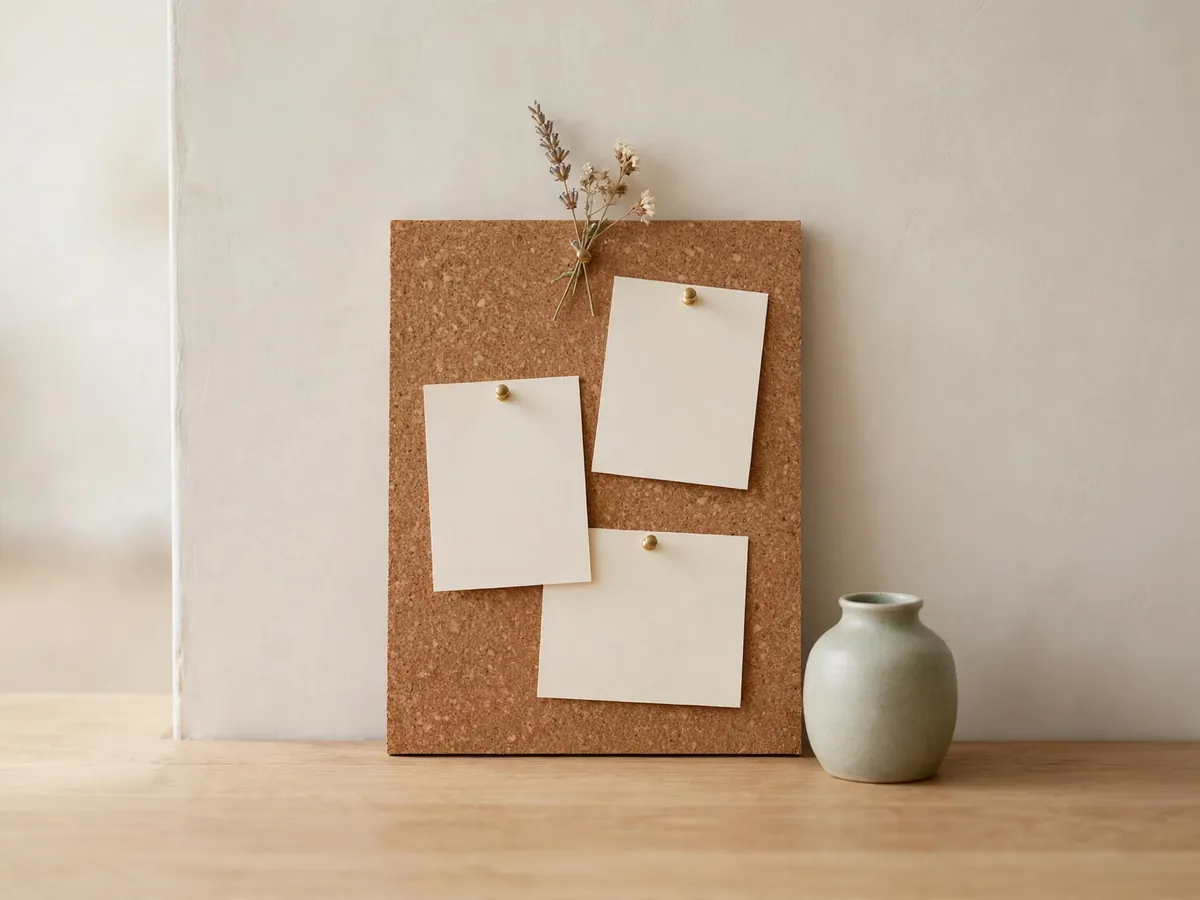
- Pick a size you can keep visible. An A4 sheet, a small cork board or a single phone wallpaper is often better than a huge poster, because it fits in the places you actually look.
- Find one to three images for each theme. Use your own photos, magazine cut-outs or pictures you save privately. Choose images that give you a quiet “yes”, not ones you think you should like.
- Add a few words or short phrases in your own voice, written as gentle statements: “I make time to cook slowly on Sundays” reads better than a list of slogans.
- Leave some empty space. White space makes the board easier to read at a glance and leaves room for things you have not imagined yet.
- Write one small, concrete action for each theme on the back or on a sticky note beside the board. This is the bridge between the picture and your week.
Examples of themes, images and small steps
Here is what a theme, its images and a matching small step can look like. Use them as starting points, not templates; your own words will always work better.
- Calm mornings: a photo of light on a kitchen table and a cup of tea. Small step: phone stays in another room until after breakfast on weekdays.
- Close friendships: a picture of people laughing around a table. Small step: send one message to a friend every Sunday evening.
- Healthy energy: an image of a forest path. Small step: a twenty-minute walk after lunch three days a week.
- Creative work: a photo of paint, clay or an open sketchbook. Small step: thirty minutes of making something on Saturday morning, with no goal for the result.
- A calmer relationship with money: an image of a tidy notebook and a plant. Small step: ten minutes on Friday to look at what came in and went out this week.
Put it where your eyes already go
Placement decides whether a board gets used. Think about the spots you look at every day without trying: the bathroom mirror, the wall above your desk, the inside of a wardrobe door, the fridge, your phone’s lock screen or the first page of the journal you already write in. Choose one of those, not the spare room you rarely enter.
If you prefer privacy, a digital board can work just as well. Save your images and words in a private album or note, and set one of them as your lock screen for a few weeks. Changing that single image now and then keeps it fresh, because the eye stops noticing anything that never changes.
Pair the board with one weekly step and an if-then plan
A vision board shows you where you want to go; a small plan helps you take the next step. One simple structure is WOOP, which stands for Wish, Outcome, Obstacle, Plan. You name a wish from your board, picture the best outcome, notice the obstacle inside you that most often gets in the way, and then decide what you will do when it shows up. The WOOP website describes it as a science-based mental strategy that people can use to pursue their wishes and change habits.
The plan part works well as an if-then sentence: “If it is Sunday evening and I feel tired, then I will send just one short message to a friend.” Research on these if-then plans, known as implementation intentions, has found that spelling out when, where and how you will act tends to help people follow through on goals. Once a week, look at your board for two minutes and ask: which theme did I act on, and what is one small step for the coming week?
Common mistakes, and what to do instead
These are the most frequent reasons a vision board stops working, along with simple fixes:
- Too many images. A crowded board becomes visual noise. Keep two to four themes and cut anything that does not give you a clear feeling.
- Only things to buy. Objects can be part of it, but a board made only of products rarely says much about how you want to live. Ask what feeling the object stands for and picture that instead.
- Copying someone else’s dream. Images from social media can look perfect yet mean little to you. If a picture makes you feel behind rather than hopeful, take it off.
- Hiding it away. A board you never see cannot remind you of anything. Move it to a place you pass every day, or make it your lock screen.
- Never updating it. Your life changes, and the board can too. Review it every season, keep what still feels true and replace what does not.
What a vision board can and cannot do
A vision board can help you get clear about what matters, keep it in sight on busy days and nudge small choices in that direction. It does not make things happen on its own and does not guarantee any outcome. The value comes from what it reminds you to do, not from the pictures themselves, so be kind to yourself when parts of it take longer than you hoped.
If making a board brings up stress, comparison or old pain, it is fine to pause or make it smaller. A vision board is a reflective practice, not a substitute for professional help, and talking to someone you trust or a qualified professional is always a reasonable step. Awen, the manifestation app we are building, will bring journaling, intentions and a private vision board together in one place; you can join the waitlist on the home page.
Frequently asked questions
Is a digital vision board as good as a paper one? It can be. What matters is that you see it often and that it feels personal. Paper suits people who enjoy making things by hand; a phone wallpaper or private album suits people who want something portable and discreet.
How many images should a vision board have? There is no fixed number, but fewer is usually better. Two to four themes with one to three images each is enough to read at a glance and still feel rich.
When should I make a vision board? Any time you want a fresh start: a new year, a birthday, the start of a season or simply a week when you feel a bit lost. Many people find it helpful to review the board each season.
Should I share my vision board? Only if you want to. Some people enjoy making boards with friends; others prefer to keep them private so they can be fully honest. Both are fine, and your board does not need anyone else’s approval.
Sources and further reading
- WOOP: Wish, Outcome, Obstacle, Plan (official WOOP website) — Describes WOOP as a science-based mental strategy that people can use to find and fulfil their wishes, set preferences and change their habits.
- Gollwitzer & Sheeran (2006): Implementation intentions and goal achievement, a meta-analysis (University of Konstanz repository) — Review of 94 independent tests on if-then plans that spell out when, where and how to act; reports an average medium-to-large effect on goal attainment.
Keep exploring
All blog posts
How to set intentions (and how they differ from goals)
A goal is a result you want to reach; an intention is the way you choose to show up while you get there. Here is how to set an intention in a few minutes, keep it small enough to live by and review it each week.
Read article
What is scripting in manifestation, and how do you start?
Scripting means writing a scene from your life as if what you hope for is already true. Here is how it works, how to write your first script in fifteen minutes and how to keep it grounded in real steps.
Read article